News & Perspectives 2.11.26
Investing in Signals
February 2026 Client Letter
How everyday observations can lead to investment ideas.
In March of 2023, I was aboard the Celebrity Beyond, somewhere between ports, when something surprised me.
Even though I had promised myself to unplug from the markets for a few days, I couldn’t resist. Silicon Valley Bank had collapsed shortly before we shoved off from Fort Lauderdale, and I was concerned about what its failure could mean for the financial system and for our investments more broadly.
Since we were at sea, I wasn’t expecting much in the way of an Internet signal.
But the Internet worked. Smoothly, quickly, without the usual buffering or dropouts that most of us associate with being miles offshore.
This wasn’t supposed to be possible. At least not according to our old assumptions about how connectivity works.
For decades, Internet access at sea meant compromise: slow speeds, limited access, and frequent disconnects. Yet there I was, staying connected to unfolding financial news as if I were sitting in my office.
The reason for this connection wasn’t the ship.
It was space.
The Celebrity Beyond was the first ship in the Celebrity fleet equipped with SpaceX’s Starlink satellite network, which officially launched aboard the ship in September 2022. Instead of relying on traditional maritime systems, the Beyond pulled connectivity directly from low-Earth-orbit satellites overhead.
That experience stuck with me. Not because the Wi-Fi was fast, but because it revealed how much of our modern life depends on infrastructure we never see. In investing, those unseen systems are often where durability resides.
For many people, space still feels abstract. Rockets. Astronauts. Distant exploration. But space is becoming part of our everyday economy, powering the systems we rely on for navigation, communication, coordination, and awareness, and now even something as ordinary as checking the markets on a cruise ship.
McKinsey estimates the global space economy could reach $1.8 trillion by 2035, driven not just by launches and satellites but by a growing layer of commercial services that support industries ranging from ride-sharing to global supply chains.
The Commercialization of Space
For most of modern history, space was primarily a government project driven by national pride, defense priorities, and scientific exploration. That is changing. Today, much of the momentum in space activity comes from private companies pursuing commercial opportunities. Governments still matter, but increasingly they are customers rather than sole operators.
Several forces have converged to make this possible. Reusable rockets, faster launch cycles, smaller satellites, and more powerful onboard computing have materially lowered the cost and complexity of getting into orbit.
At the center of this shift is SpaceX, which has reset expectations for launch economics and satellite deployment. SpaceX remains a private company, and while there have been periodic reports that it could go public at some point, it is not currently accessible to public-market investors. Even so, its influence is hard to ignore. By normalizing frequent, low-cost launches and deploying thousands of satellites through its Starlink network, SpaceX has effectively forced the rest of the industry to respond.
That response is taking shape through a small number of emerging players. Rocket Lab (RKLB) has positioned itself as a specialist in smaller, more flexible launches and space systems, while AST SpaceMobile (ASTS) is working to build a satellite-based communications layer designed to connect directly with everyday mobile devices. These companies are still early in their development and are not yet consistently profitable, but their progress shows how rapidly the space market is evolving beyond a single dominant player.
What matters for investors is not simply who launches rockets but what those launches enable.
Satellites now form a critical layer of economic and security infrastructure, connecting data, monitoring the planet, supporting defense systems, and extending digital networks far beyond traditional ground-based limits.
This evolution helps explain why space is drawing growing attention from both commercial customers and governments. Space has become a strategic asset, and reliability has become the defining feature. These systems are expected to work continuously, often in environments where failure carries significant consequences.
________________________________________
Key Takeaway
The space economy isn’t about rockets—it’s about reliability.
________________________________________
And that is where companies such as L3Harris Technologies (LHX), Northrop Grumman (NOC), and General Dynamics (GD) come into the picture. These firms aren’t just building planes and ships; they are deeply involved in satellites, secure communications, missile-warning systems, and the digital backbone that keeps both civilian and national systems functioning.
How Our Portfolio Already Touches Space
Our exposure to the space economy is not limited to any one company or theme. In addition to defense firms such as LHX, NOC, and GD, several companies we own for clients play supporting roles behind the scenes. Communications providers such as AT&T (T) and Verizon Communications (VZ) help integrate satellite connectivity into everyday networks, while industrial companies like Cummins (CMI) and Emerson Electric (EMR) supply the power systems, controls, and automation that keep mission-critical infrastructure running.
Taken together, these holdings reflect an important reality: space today is less about exploration and more about dependable infrastructure underpinning everyday activity.
When we talk about investing in space, we’re not talking about speculation on distant planets. We’re talking about investing in the systems that modern life increasingly depends on, often most visible only when they fail, or when, unexpectedly, they work perfectly hundreds of miles from shore.
Uber: When Labels Start to Break
Not too long ago, while reviewing sector weightings within the S&P 500, I noticed something that caught my attention. Uber Technologies (UBER) was one of the largest holdings within the industrial sector, alongside traditional names such as Caterpillar (CAT), Union Pacific (UNP), and Boeing (BA).
At first glance, that feels counterintuitive. Many of us consider Uber to be a ride-sharing company or perhaps a technology company. Both descriptions are accurate, but they don’t fully capture what the business has become.
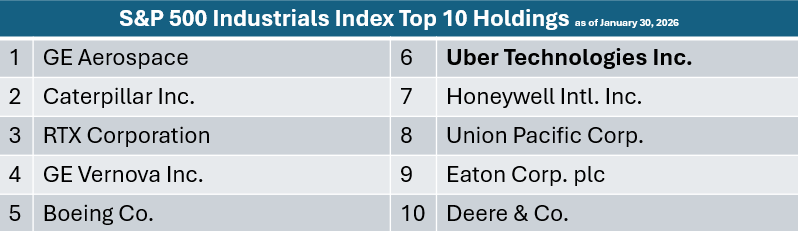
Uber isn’t simply matching riders with drivers. It is coordinating logistics, routing, pricing, and real-time demand across massive networks. In that sense, Uber increasingly behaves less like a consumer app and more like a transportation and logistics platform. The classification wasn’t about what Uber looks like on a smartphone screen. It was about the role it plays in the economy.
That realization stuck with me because it reflects a broader shift underway. Traditional sector labels are becoming less reliable as guideposts. Businesses are no longer defined solely by what they sell but by the systems they operate and the problems they solve. Software, data, and connectivity are reorganizing parts of the economy that were once firmly physical and industrial.
Uber’s partnership with Kroger (KR), which we own for clients, is a good example. Years ago, the idea of a ride-sharing platform working closely with a grocery chain might have seemed like an odd pairing. Today, it makes more sense. The relationship is less about transportation and more about logistics, fulfillment, and last-mile delivery, areas where coordination and infrastructure matter more than labels.
We do not own Uber for clients, and this observation is not a recommendation. Rather, it serves as a signal. When businesses begin to blur traditional boundaries, whether industrial, technological, or consumer, it often reflects deeper changes in how the economy functions. Paying attention to those signals can be just as important as studying financial statements or valuation metrics.
The common thread in these examples is not the companies themselves but the way change tends to reveal itself. Often it shows up first through small, practical signals—how people move, communicate, manage power, or address long-standing problems—well before those shifts are fully reflected in economic data.
Vertiv and Sterling: Following the Infrastructure Trail
In the summer of 2024, a longtime client mentioned a company to me that wasn’t fully on my radar: Vertiv Holdings (VRT). Jerry is a no-nonsense individual, an accountant by training, someone who has ridden Harley-Davidsons for years, and pilots airplanes. He has never struck me as speculative or prone to chasing trends. In fact, this was one of the first times I can remember him introducing a company to me rather than the other way around.
That prompted a closer look.
At the time, I was familiar with Vertiv only in a general sense and had not formed a clear investment thesis. As I looked more closely, one detail stood out. Vertiv was formerly part of Emerson Electric, a company we have owned for clients for many years. Within Emerson, the business operated as Emerson Network Power, supplying power management and cooling systems for mission-critical environments. To me, lineage mattered. Emerson has been around since the 1800s, and its culture has long emphasized engineering, reliability, and industrial discipline.
The timing of this discovery was important. As interest in artificial intelligence accelerated, it became increasingly clear that AI was not just a software story. It was and still is a power and infrastructure story. Data centers require enormous amounts of electricity, cooling, and redundancy. Chips and algorithms cannot function without stable systems underneath them.
That line of thinking led from power to physical infrastructure and eventually to Sterling Infrastructure (STRL), which we also own for clients. Sterling specializes in the groundwork required before digital infrastructure can operate, including site development, civil engineering, and transportation projects that support large-scale industrial and data-center construction.
During my analysis of Sterling, one development in particular stood out. Sterling acquired CEC Facilities Group, a specialty electrical and mechanical contractor based in Texas. CEC designs, installs, and maintains electrical infrastructure for mission-critical facilities, including semiconductor plants, data centers, and advanced manufacturing sites. The acquisition expanded Sterling’s capabilities beyond earthmoving and site preparation into the electrical systems that ultimately bring these facilities to life.
For us, Vertiv and Sterling represent a way to participate in the growth of AI and data centers without focusing solely on chips or software. They sit lower in the stack, closer to the physical systems that must function reliably for everything above them to work. These are not headline companies, but they operate in areas where failure is not an option and where demand tends to persist once infrastructure is in place.
Eli Lilly: When the Mechanism Changes
Healthcare often evolves gradually until one shift changes the direction of an entire field. Over the past several years, one such shift has taken place around metabolic disease and weight management.
America’s struggle with weight is not new. For decades, we have cycled through workout programs and food trends, from Jane Fonda aerobics to The Atkins Diet and countless variations in between. While many of these approaches worked for individuals, they shared a common assumption: that sustained weight loss depended primarily on long-term human discipline. And while discipline matters, biology, habit, and metabolism consistently proved stronger than good intentions. Despite decades of effort, the United States entered the 2020s more overweight and more diabetic than ever.
What appears to be changing is not motivation but mechanism. New GLP-1-based therapies shift the burden away from willpower and toward biology, directly targeting appetite signaling and metabolic regulation. When outcomes rely less on daily compliance and more on physiological response, adoption and durability can look very different from prior weight-loss cycles.
In August 2025, we initiated a position in Eli Lilly and Company (LLY) and exited our position in Medtronic (MDT). This was not a judgment on the value of medical devices nor a claim that weight-loss drugs represent a permanent solution to obesity. Rather, it reflected our view that momentum in healthcare had shifted toward the treatment of metabolic diseases, and that Lilly had been an early and effective leader in that area.
This is not a certainty or a cure-all. Long-term adherence, side effects, insurance coverage, regulatory scrutiny, and competition will shape outcomes, and adoption may evolve unevenly over time. As with other themes in this letter, the decision was not about chasing headlines but about recognizing when a long-standing problem begins to be addressed in a meaningfully different way and adjusting the portfolio accordingly.
Meta: Scale, Resilience, and Invisible Infrastructure
Several years ago, I heard a statistic on a podcast that made me pull over the car so I could rewind it and write it down. The number was simple but startling: roughly 3.5 billion people use a Meta Platforms (META) application each month.
Put differently, a large portion of the world’s Internet-connected population interacts with Facebook, Instagram, WhatsApp, or Messenger on a regular basis. You don’t need much more context than that to appreciate the scale.
That scale became more tangible for us during Hurricane Ian here in Naples. In the aftermath of the storm, traditional text messaging was unreliable. Cellular networks were strained, and communication was inconsistent. What did work, however, was Meta’s WhatsApp. Messages went through when standard texts did not. One reason is that WhatsApp is designed to operate efficiently on limited data, which can make it more resilient when networks are degraded. In moments like that, the distinction between a social app and critical communications infrastructure blurs.
This is part of what makes Meta interesting to study. While the company is still primarily an advertising business in terms of revenue, much of what it’s building increasingly resembles infrastructure. Meta is involved in undersea fiber-optic cables that help move data across continents, and it continues to invest in data centers, artificial intelligence, and large-scale computing systems. These are not consumer-facing features, but they are essential to keeping global networks functioning.
Power has become a limiting factor in that buildout. To support its next generation of data centers, Meta has entered into nuclear-energy agreements with companies including Oklo, Vistra, and TerraPower. These arrangements are intended to provide large amounts of reliable, clean electricity over the coming decade. The takeaway is not the specific technology but the signal it sends. Computing at this scale requires long-term, dependable energy sources, not just incremental efficiency gains.
We own Meta for clients, but not because it is a social media company. We view it as a business operating at the intersection of communications, data, and infrastructure—areas where reliability and scale increasingly matter. As with other examples in this letter, these systems tend to fade into the background, becoming most visible only when conditions are stressed.
Reliability in a Changing Economy
Over the past several months, I’ve described familiar businesses and technologies in slightly different ways: Apple as a modern-day consumer staple, Google Search as a modern utility, artificial intelligence as the next iteration of the Internet, and Uber as part of the industrial economy. More recently, we’ve discussed how power and energy infrastructure have become critical bottlenecks behind data centers and AI systems. These descriptions aren’t meant to suggest that the rules of investing have changed but rather that the economy itself continues to evolve.
It’s understandable to feel uneasy whenever phrases like “new economy” enter the conversation. Many investors remember hearing similar language during the late 1990s, when technology enthusiasm ran ahead of earnings, cash flow, and reality. We’re mindful of that history. Our approach today is not to chase novelty but to participate by investing in companies we believe share many of the same characteristics we’ve always favored: scale, strong balance sheets, durable business models, and, in many cases, consistent dividend payments.
What has changed is not the discipline but the backdrop. Technology is increasingly embedded in how the global economy functions, how people communicate, how goods move, how power is generated and consumed, and how systems remain reliable during stress. By focusing on companies that are, in our opinion, integral to those systems rather than on speculative ideas built on hope alone, we believe it is both prudent and necessary to participate in these long-term trends.
As always, we’re here to help you navigate what’s next. If your financial situation has changed—or if you have questions about your investment portfolio—please don’t hesitate to call us at (800) 843-7273.
Warm Regards,
Matthew A. Young
President and Chief Executive Officer
News & Perspectives 1.27.2026
January 27th, 2026
>>The new tax rules that can get you a bigger refund this year
>>US Core Capital Goods Orders Rise for Fifth Straight Month, Boosting Economic Outlook
>>UnitedHealth stock falls as Medicare blow blots out upbeat 2026 profit forecast
>>Florida Atlantic University Signs $20M Agreement to Purchase Advantage2 Quantum Computer from D-Wave
News & Perspectives 1.22.26
January 22nd, 2026
>>Why sticking to your savings plan beats panic buying gold or crypto
>>Analysis-China can’t make consumers buy goods, so it leans on services to drive economy
>>Google Acquires Top Talent From AI Voice Startup Hume AI in Licensing Deal
>>Microsoft Awarded $170M Air Force Task Order to Support Cloud One
News & Perspectives 1.15.26
January 15th, 2026
>>Kroger Launches Fast, Convenient Delivery on Uber Apps Nationwide
>>Dell admits users don’t care about AI PCs, refocuses on what matters
>>Vertiv introduces new modular liquid cooling infrastructure solution to support high-density compute requirements in North America and EMEA
>>Lilly, chasing Novo, expects second-quarter FDA decision on obesity pill
News & Perspectives 1.14.26
Investing In What Doesn’t Announce Itself
January 2026 Client Letter
A look at the forces shaping markets beneath the headlines.
January has a way of pulling our attention forward. Investors start asking what the year ahead might bring and whether the decisions they carried into the new year still make sense. After a year filled with fast-moving headlines and changing narratives, that reaction is understandable.
What can be easier to miss is where progress comes from. In investing, the most important work rarely happens at moments of clarity. It tends to occur during periods that feel uneven or unresolved, when progress is being made before results are obvious.
I was reminded of that recently in a personal way. Two years ago, I routinely finished Peloton rides near the top of my age group. A couple of minor injuries last year forced me to step back and rebuild. Improvement did not come from pushing harder. It came from consistency, recovery, patience, and showing up day after day, even when the gains were hard to see.
Investing often works the same way. Periods that feel least productive on the surface are often the ones laying the groundwork for future success.
This perspective shapes how I think about a new year. Rather than focusing on predictions or short-term market calls, I find it useful to think about positioning and the forces shaping outcomes before they become widely recognized.
What follows is not a forecast for 2026; it is a framework for thinking about risk, opportunity, and portfolio construction within a much longer game.
Why We Think Long-Term—Even When the Calendar Says Otherwise
Before talking about 2026 specifically, it helps to explain how I think about investing more broadly. I do not spend much time fixated on one-year outcomes. My approach has always been continuous and long term, not neatly segmented into calendar boxes. Businesses do not operate on twelve-month scorecards, and successful long-term investing rarely does either.
Markets, however, are often judged on a much shorter horizon. Investors often measure success or failure over quarters and calendar years. One of the largest assets most of us own is our home. If the real estate market weakens and the estimated value declines, does that alone prompt a sale? Of course not. Most homeowners do not even check the value regularly, and when they do, short-term fluctuations are largely irrelevant unless a move is imminent.
A portfolio of stocks deserves the same perspective. A declining stock price does not automatically signal a problem. There are times when fundamentals change and selling makes sense. More often, price declines reflect shifts in sentiment rather than deterioration in business value. In those moments, lower prices can represent opportunity rather than failure.
Warren Buffett has long described stocks as ownership stakes in real businesses, not trading vehicles judged by daily price movements. Seen through that lens, short-term volatility matters far less than long-term earning power, balance-sheet strength, and competitive position.
I also recognize the reality investors live with. Markets are visible every day, and performance is easy to track in real time. Even so, January has become a moment when people naturally step back and ask what comes next. With that context in mind, it’s worth thinking about how the past year unfolded and what may feel different as we move ahead.
A Year Where Headlines May Carry Less Weight
March and April of last year delivered a dense stretch of headline pressure. Questions around tariffs, currency movements, and speculation about Federal Reserve independence arrived almost at the same time. It was not just the issues themselves that mattered but how tightly they were clustered.
What made that period challenging was not only what investors were reacting to but also how little time there was to digest one development before the next arrived. Markets often struggle most when several unknowns overlap.
The headline environment in 2026 may feel different. The early phase of a new administration brought a fast pace of policy announcements and frequent recalibration. That pace appears to have begun to slow. Headlines will not disappear, but fewer major unknowns may be competing for attention all at once.
Not all headlines carry the same weight. Some events are dramatic without being destabilizing. Others introduce uncertainty that lingers. Markets tend to care less about the volume of news and more about whether outcomes can be reasonably assessed.
History suggests that when uncertainty shifts from unknown to understood, markets adapt. Even significant developments become more manageable once they are absorbed and priced. In those moments, headlines lose their power not because they matter less but because their implications are clearer.
This does not suggest a calm year or an absence of surprises. It simply reflects how markets typically work. Not every headline deserves the same attention, and some developments, despite their significance, ultimately ease pressure rather than add to it.
Venezuela, Energy, and a Different Kind of Headline
One recent development involving Venezuela is a good reminder that not all headlines have the same implications for markets.
For years investors have heard that the United States is energy independent. There is truth to that, but it doesn’t tell the whole story. The U.S. produces large amounts of light, sweet crude oil. Many of the nation’s largest refineries, particularly along the Gulf Coast, were built decades ago to process a different product entirely: heavier, sour crude.
Venezuela is one of the most efficient sources of that type of crude. When access was restricted, U.S. refiners had to adjust. Heavier crude was sourced from farther away, often at higher cost and with less efficiency. The result was not an oil shortage but a system that operated with more friction.
Recent U.S. action in Venezuela has the potential to change that dynamic. If it leads to renewed access and investment, it could improve supply reliability, support refinery margins, and allow the refining system to operate more smoothly. In practical terms, that matters for energy companies, fuel costs, and inflation.
This is where the distinction between dramatic and destabilizing becomes relevant. Events that improve access, logistics, or efficiency can be constructive even when they dominate headlines. Lower energy input costs may ease pressure on consumer prices. That, in turn, can give the Federal Reserve more flexibility as it evaluates future policy decisions.
From a portfolio perspective, this is not about politics or short-term speculation. It is about understanding how energy markets function, how infrastructure constraints affect profitability, and how changes in supply chains ripple through the broader economy.
Not every geopolitical event increases uncertainty. Some, once understood, reduce it.
A Reasonably Supportive Environment for Stocks
Rather than trying to forecast where markets might land, I find it more useful to focus on the conditions businesses are operating in and how those conditions are evolving.
Economic growth has slowed from its post-pandemic pace, but it has not stalled. Employment is easing without showing clear signs of stress, and companies continue to invest even with a higher cost of capital. Inflation pressures have moderated, which should provide policymakers more flexibility than they had a year ago.
That flexibility matters. If interest rates continue to move lower, financial conditions gradually become less restrictive. Balance sheets improve. Refinancing becomes easier. Cash flow stabilizes. None of this guarantees strong market returns, but it does tend to create a more workable environment for businesses over time.
There is also more discussion around margin expansion. After several years of rising costs, some of the biggest headwinds are starting to settle. Wage growth has moderated. Supply chains are more predictable. Input costs, while still elevated in certain areas, are better understood. Businesses do not need perfect conditions. They need clarity.
At the same time, many companies spent the past few years investing heavily in productivity. Automation, software, and infrastructure upgrades were not optional. They were necessary to stay competitive. The return on those investments rarely shows up immediately in reported earnings, but over time, they can improve efficiency and support margins.
Taken together, steady growth, easing inflation pressures, improving visibility, and years of productivity investment do not eliminate risk. Markets rarely move in straight lines. But when these building blocks behave, equities have often had room to work over time.
A Quiet Support: The 65‑Year‑Old Consumer
Much of the conversation around the U.S. consumer today centers on strain. Housing costs are elevated. Insurance premiums have risen. Everyday expenses feel more noticeable. These pressures are real, but they do not describe every part of the economy equally.
One of the quieter sources of support comes from demographics. More Americans are turning 65 than at any point in the country’s history, and that trend is expected to continue for several more years. Many in this group are entering retirement with meaningful savings, home equity, and steady sources of income, including pensions and Social Security.
Spending patterns tend to change at this stage of life, but they do not disappear. Travel, leisure, healthcare services, and experiences often move higher on the priority list. Just as important, spending does not stop at the individual level. Financially secure retirees often help support adult children and grandchildren, whether through childcare, education expenses, or assistance with housing.
The result is a consumer landscape that is more nuanced than broad averages suggest. While some households remain under pressure, others continue to draw on savings accumulated over decades. Demand does not vanish. It shifts.
This does not eliminate the risk of a slowdown, nor does it suggest that all consumers are thriving. It helps explain why economic resilience has persisted even as concern about the consumer remains widespread.
The Fourth Industrial Revolution, Hiding in Plain Sight
When most people think of an industrial revolution, they picture railroads, factories, pipelines, and power plants. Steel, energy, and heavy machinery come to mind. These were visible transformations, easy to recognize even as they were taking shape.
The current one looks different.
Much of today’s industrial change is happening behind fences, inside data centers, and within existing infrastructure. It is being driven by artificial intelligence, robotics, and compute-intensive systems that require enormous amounts of power, cooling, and physical support.
Because the outputs are digital, it is easy to underestimate the scale of what is being built.
That is where this revolution hides.
Before a single AI model runs, land must be prepared, equipment moved, and power secured. This is not a virtual process. It is a construction and infrastructure effort unfolding in real time.
Companies like Caterpillar supply the equipment needed to prepare sites and build large-scale facilities. Emerson Electric provides automation and control systems that manage complex industrial and energy environments where precision matters more than speed. Cummins sits at the intersection of legacy and transition, supplying power solutions while adapting to cleaner and more flexible energy systems.
Even regulated utilities, often viewed as slow moving, have become central participants. Companies such as Duke Energy, NextEra Energy, and Southern Company are increasingly essential partners in supplying reliable electricity to a more energy-intensive economy.
What makes this phase of investment notable is not just its scale but its durability. These projects are not one-time events. They require ongoing maintenance, upgrades, and expansion. The infrastructure supporting this cycle is being built to last, and demand tends to build on itself over time.
Many of the businesses involved share another characteristic that often receives less attention during periods of rapid technological change. They generate cash flow and return capital to shareholders. Dividends may not dominate the conversation around artificial intelligence or data centers, but over time they can remain a meaningful contributor to total return, particularly when paired with sustained reinvestment and long-term demand.
This is often how major economic shifts unfold: not all at once, and oftentimes not in the places people expect to look.
Beyond the Acronyms: A Market of Stocks, Not Seven Names
One of the more interesting market developments last year was not what dominated the headlines but what contradicted them.
Much of the recent investing narrative has centered on the idea that a small group of mega cap technology companies is the stock market. Acronyms simplify complex realities, and over time, that simplification can harden into assumption. The assumption, in this case, is that if those few names are driving returns, everything else must be standing still.
That was not what actually happened.
Five of the seven companies most often cited as market leaders underperformed the broader market last year. I do not view that as a warning sign or a loss of leadership. Stocks move in cycles. Even exceptional businesses pause, consolidate, or simply hand the baton to others for a time.
What mattered more was what that pause revealed.
It showed that markets still reward execution beyond the most crowded trades. Performance broadened across industries and business models, often in places receiving far less attention. The stock market, as it turns out, remained a market of stocks.
That distinction matters. When investors become overly focused on a narrow set of names or narratives, decision-making can become distorted and opportunity easier to miss. Over time, durable returns tend to come not from guessing which acronym will dominate next but from owning a diversified collection of businesses with different drivers, cycles, and sources of revenue.
That dynamic may become more visible in the year ahead. Markets rarely move forward on a single track. Leadership rotates. Capital flows adjust. New contributors emerge. When that happens, diversification stops feeling theoretical and starts feeling practical.
Why These Themes Matter—and Why Time Still Matters More
Taken individually, none of these themes is revolutionary. Headlines ebb and flow. Economic conditions shift. Demographics evolve. Infrastructure gets built. Leadership rotates. These are familiar features of markets over time.
What matters is how they come together.
Periods when economic growth remains intact, cost pressures ease, productivity improves, and participation broadens tend to reward discipline more than drama. They are rarely obvious in real time. Progress often appears uneven, and leadership seldom moves in a straight line.
The temptation, especially after an eventful year, is to focus on what might happen next. In our experience, the more durable advantage comes from being positioned thoughtfully before outcomes become clear.
That perspective shapes how we approach portfolio construction. Rather than trying to predict short-term moves or react to every new narrative, we focus on owning a diversified collection of durable businesses. Companies with real cash flow. Balance sheets that can absorb change. Competitive positions that allow them to adapt as conditions evolve.
Time remains an underappreciated part of that equation. It allows productivity investments to compound. It allows margins to normalize. It allows businesses with durable cash flows to raise dividends year after year, contributing to total return in ways that are easy to overlook in any single calendar year. It also allows cycles to play out and leadership to rotate without forcing constant decisions.
None of this eliminates uncertainty. Markets will always test patience. Headlines will continue to demand attention, and periods of volatility are inevitable. Over time, however, investors who stay focused on fundamentals, diversification, and a long-term horizon tend to be better positioned to participate in progress without reacting to every headline along the way.
That is the mindset we bring into 2026. Not as a forecast but as a framework. One that recognizes change without chasing it and opportunity without overstating it.
As always, we’re here to help you navigate what’s next. If your financial situation has changed—or if you have questions about your investment portfolio—please don’t hesitate to call us at (800) 843-7273.
Warm Regards,

Matthew A. Young
President and Chief Executive Officer