News & Perspectives 10.16.25

October 16th, 2025
>>OpenAI has 2 kinds of dealmaking — and they’re lopsided
>>TSMC profit surges 39% to beat estimates and hit yet another record on AI chip demand
>>US Retail Sales Likely Rose in September; Higher-Income Consumers Drive Growth
>>Big Changes Are Coming for 2026 Medicare Plans. What You Need to Know.


News & Perspectives 10.15.25

October 15th, 2025
>>‘Absolutely’ a market bubble: Wall Street sounds the alarm on AI-driven boom as investors go all in
>>IRS unveils higher capital gains tax brackets for 2026
>>Governments are spending billions on their own ‘sovereign’ AI technologies – is it a big waste of money?
>>You’ll soon be able to shop Walmart from ChatGPT


News & Perspectives 10.14.25

October 14th, 2025
>>Economists Mark Up US Growth Forecasts, See Tepid Job Gains, Survey Shows
>>JPMorgan Chase tops estimates as trading revenue hits a record of nearly $9 billion
>>AMD and Oracle announce agreement for 50,000 GPUs as AI deal spree continues
>>Larry Ellison’s Latest Gambit to Keep Oracle on Top Is His Biggest Bet Ever


News & Perspectives 10.13.25

October 13th, 2025
>>US households to flip to net buyers of stocks in 2025, Goldman Sachs says
>>Broadcom stock pops 7% on OpenAI custom chip deal, adding to Nvidia and AMD agreements
>>Why Gold Will Lose Its Luster
>>Is AI fueling a stock market bubble? We debate it.


Investing In Data Centers

September 2025 Client Letter

Last month, I drove my son to Gainesville to begin his junior year at the University of Florida. Moving into the fraternity house began with an introduction to a black box mounted beside the front door. It was a newly installed contactless entry system powered by near field communication (NFC). The brotherhood simply tap their phones near the reader to gain entry.

NFC lets devices talk to each other within a few centimeters. It’s the same technology behind tap-to-pay cards and mobile wallets. The setup offers secure, fast access without physical keys or shareable codes.

Later that night, we grabbed dinner at BJ’s, which uses a QR-based payment system. Scan the code at the table, view the bill, and pay via mobile wallet. No waiting for the server, no paper receipts.

Conveniences like these are nudging me toward a wallet-less lifestyle. I sometimes carry a minimalist wallet, but increasingly prefer my iPhone for secure, hassle-free payments.

While iPhones have been around for years, I’m still struck by all their applications. Navigation, payments, communication, reservations, entertainment, news, research, weather reports, and coupon clipping. All indispensables.

I don’t view Apple as a tech company. I see it as a modern consumer staple. Some push back on that comparison, but I ask: Would you rather go a week without toothpaste or without your iPhone? Personally, I’d manage without toothpaste. A week without my iPhone? That’s a logistical meltdown. For me, the device is command central.

We rely on our phones to connect with countless services, often without a second thought about the infrastructure making it all possible. That invisible layer is one of the main areas where today’s digital revolution is unfolding. And at the center of it all are data centers.

Digital Mines: The Role of Data Centers in the Data Economy

Data is increasingly seen as the raw material of the digital economy. Much like gold was for industrial economies. While gold fueled wealth creation in past centuries, data now powers innovation, automation, and decision-making across nearly every sector.

Often described as “mining the new gold,” data centers are where the value of information is unlocked. These facilities store, process, and transmit the data behind everything we do online. From email and streaming to navigation and shopping. Data centers comprise servers, networking gear, and systems for power and cooling. Think of them as digital factories where data is refined and distributed.

If data is the new gold, then data centers are the mines. From contactless entry systems to mobile payments, we interact with data-rich technologies constantly. Behind every tap, scan, or swipe is an infrastructure built to keep that data secure, accessible, and flowing.

Mapping the Mines: Types of Data Centers and Who Runs Them

There are several types of data centers, each playing a distinct role in the digital ecosystem:

  • Hyperscale centers are operated by tech giants like Amazon Web Services, Google Cloud, Microsoft Azure, Meta (with Prometheus coming online in 2026 and Hyperion under development), and Oracle Cloud Infrastructure. These facilities support millions of users and vast computing workloads.
  • Enterprise centers are owned by individual companies for internal operations. JPMorgan Chase uses them to support secure financial transactions, Walmart to manage logistics and inventory, and Coca-Cola to oversee global supply chain and marketing data.
  • Colocation centers allow businesses to rent space from third-party providers such as Equinix and Digital Realty, offering flexibility without the need to build and maintain their own infrastructure.
  • Edge centers are located closer to end users to reduce latency and improve response times, which are critical for applications like autonomous vehicles and real-time analytics.
  • Cloud-based centers may appear virtual to users but rely on physical infrastructure. This is the model many small businesses use to store and access our files, email, and internal systems.

Artificial intelligence is accelerating demand for data centers. Machine learning models require massive computing power and storage, creating a feedback loop: more data leads to better models, which in turn require more infrastructure. This dynamic has sparked a surge in investment across the data center landscape.

For investors, understanding the role of data centers is increasingly important. These facilities aren’t just technical assets. They’re central to the growth of AI, cloud computing, and digital services. As demand continues to rise, companies that build, power, and support data centers may offer long-term investment opportunities.

Foundational Players in the Data Center Ecosystem

With data centers playing a foundational role in the digital economy, several companies are generally recognized for their strategic contributions to building and supporting the infrastructure behind it:

  • Alphabet (Google)
    Alphabet has earmarked $75 billion for AI-ready data centers, scaling aggressively with a focus on energy-efficient infrastructure and custom silicon (TPUs). This investment supports its shift from ad-centric to platform-centric revenue, potentially positioning Alphabet as a leader in cloud and AI infrastructure.
  • Amazon (AWS)
    Amazon Web Services operates one of the world’s largest hyperscale data center networks. With over $150 billion invested in infrastructure, AWS is partnering with NVIDIA on liquid cooling for AI workloads, an indicator of its commitment to next-generation efficiency.
  • Broadcom
    Often overlooked, Broadcom plays an important role in digital infrastructure. Its networking chips move vast amounts of data quickly and efficiently, enabling large-scale AI systems. As data center traffic grows, Broadcom’s expertise in routing and switching makes it an enabler of modern computer environments. Its technology is embedded in many of the world’s largest cloud and enterprise data centers.

  • Dell Technologies
    Dell builds the hardware behind private cloud, edge computing, and AI workloads. It helps enterprise clients modernize without starting from scratch, offering scalable systems and leading in liquid cooling. Liquid cooling technology is increasingly responsible for managing heat in high-performance AI systems. Dell’s latest servers can reduce cooling energy costs by up to 60%, making data centers more efficient. While not a hyperscaler, Dell’s infrastructure is widely used across enterprise environments.
  • Meta
    Meta is investing $65 billion in hyperscale and edge data centers to support AI and augmented reality / virtual reality platforms. Its use of immersion cooling reflects the intensity of its computer needs and its long-term bet on spatial computing.

  • NVIDIA
    NVIDIA has evolved from a chipmaker into a full-stack systems company helping power the AI revolution. Its GB200 NVL72 platform, built on the Blackwell architecture, delivers rack-scale performance with advanced liquid cooling for trillion-parameter AI models. NVIDIA’s infrastructure strategy now includes reference designs for “AI factories,” integrating computer, cooling, and power systems into unified, simulation-ready environments.

Building the Foundation: Companies Powering Data Center Infrastructure

While companies like Amazon, Alphabet, and NVIDIA lead the computer and platform layers of digital infrastructure, others play important roles in building and enabling the systems that support them:

  • Sterling Infrastructure
    Sterling specializes in site development for data centers, including excavation, grading, and utility installation. In March 2024, its subsidiary Plateau Excavation secured a $100 million contract for a data center project in the southeastern U.S., spanning 280 acres and involving 125,000 linear feet of underground infrastructure. This award reflects strong demand from hyperscale clients expanding capacity for AI and cloud workloads.

    Sterling offers exposure to the physical buildout of digital infrastructure, which is a less crowded but necessary corner of the market. Its E-Infrastructure segment accounts for over 65% of its backlog, with data-center-related activity growing 60% year over year in early 2025. Sterling’s ability to deliver complex, mission-critical projects on time appears to have made it a trusted partner for hyperscale developers.

  • Vertiv Holdings
    Vertiv provides the power infrastructure essential for AI data centers, where rack-level energy demands now exceed 300 kilowatts. It is pioneering 800 VDC architectures, aligned with NVIDIA’s AI roadmap, to deliver power more efficiently while reducing copper use and thermal losses.

    Vertiv’s portfolio includes DC busways, converters, backup systems, battery storage, and microgrid solutions that help reduce reliance on utilities. It also leads in direct-to-chip and immersion liquid cooling, which is critical for managing heat in high-performance AI environments. Its MegaMod CoolChip modular systems integrate cooling and power, enabling hyperscale deployments up to 50% faster than traditional builds.

    As density and energy needs rise, Vertiv’s end-to-end infrastructure, from grid to chip, positions it as an important component in the evolving architecture of AI infrastructure.

AI Valuations: Hype, Reality, and Risk

In mid-August, OpenAI CEO Sam Altman stirred debate with candid remarks to Bloomberg about investor enthusiasm for artificial intelligence. When asked whether we’re in an AI bubble, Altman replied, “Are we in a phase where investors as a whole are overexcited about AI? My opinion is yes.” He likened the current mood to the dot-com era, noting that “when bubbles happen, smart people get overexcited about a kernel of truth.”

Altman emphasized that AI is indeed that kernel. A transformative technology he called “the most important thing to happen in a very long time.” At the same time, he acknowledged that some startup valuations are irrational and warned that “someone will lose a phenomenal amount of money.”

These comments came as OpenAI was negotiating a secondary share sale valuing the company at $500 billion despite being just a few years old. Altman’s remarks appear to strike a balance: cautioning against investor exuberance while reaffirming his belief in AI’s long-term significance.

Why Today’s AI Market Looks Different

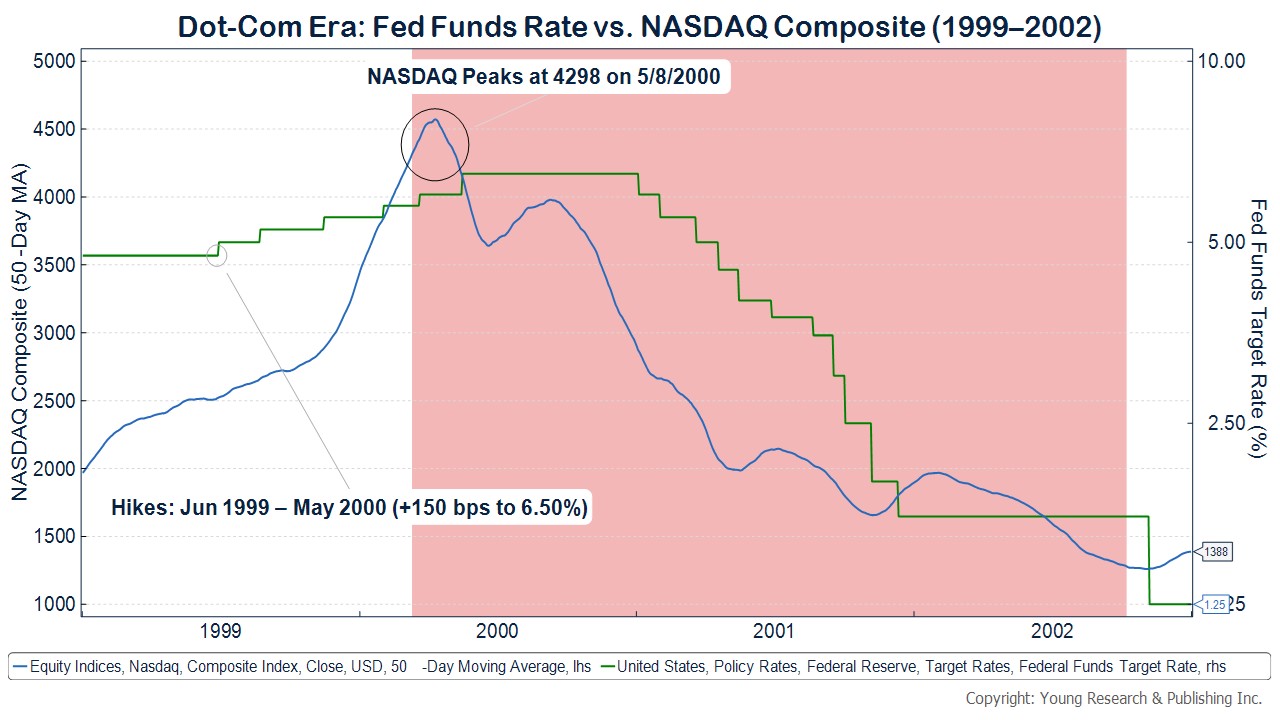
While Altman’s warning is worth noting, today’s environment appears to differ from the dot-com era. In 2000, the Federal Reserve tightened financial conditions, raising interest rates five times as valuations peaked. Today, we’re seeing the opposite. Rate cuts have begun. An easing could provide a tailwind for both the economy and equity markets.

Meanwhile, the AI spending continues, helping to fuel GDP, corporate earnings, and stock prices. Businesses and investors are directing tens of billions toward AI infrastructure, software, and applications.

We’ve just wrapped up a better-than-expected earnings season for Q2, and from what I can tell, Q3 looks positive as well. I believe when paired with a Federal Reserve in rate-cutting mode, the combination of earnings growth and AI investment creates a potentially favorable backdrop for equities. A bubble may eventually form, but it doesn’t appear to be on our doorstep today. If spending slows, earnings soften, and the Fed reverses course, then conditions would most likely shift. But for now, fundamentals seem to remain supportive.

As always, we’re here to help you navigate what’s next. If your financial situation has changed or if you have questions about your investment portfolio, please don’t hesitate to call us at (800) 843-7273.

 Warm Regards, 


Matthew A. Young 
President and Chief Executive Officer


News & Perspectives 9.23.25

September 23rd, 2025
>>Apple, Meta power 27% of Q2 S&P 500 buybacks despite 20% drop
>>Stocks Are Outrunning Tariff Risks as Earnings Expectations Rise
>>U.S. Investors Are Flush With Cash, and Happy to Keep It There
>>Jonathan Clements, Longtime WSJ Columnist, Dies at 62


Investing in an Era of Disruption

August 2025 Client Letter

In an age of constant media churn, politics often dominates the news headlines. For investors, this sometimes makes it challenging to separate fact from opinion or find a clear, nonpartisan view of what’s really happening. Many are understandably frustrated when one network reports a story one way, only to hear a completely different take on another. This kind of polarization can make it harder to invest with confidence.

A prime example of this dynamic was on display with the release of the July U.S. jobs report.

The numbers were disappointing: only 73,000 jobs were added, well below the consensus estimate of 100,000. Worse, job gains for May and June were revised down by a combined 258,000, bringing the three-month average to just 35,000, a level that historically signals economic trouble.

Politically, the left suggested immigration policy as a factor, citing a sharp drop in the number of foreign-born workers in the labor force. Meanwhile, the right questioned the reliability of the data itself. President Trump even dismissed the head of the Bureau of Labor Statistics, alleging bias in the reporting.

Yet amid the finger-pointing, one critical factor may be slipping under the radar. The disruptor might not be immigration or data reliability, but instead artificial intelligence. The July employment report may be less about policy and more about a technological shift that’s transforming how work gets done.

AI Shaking up the Labor Market

Artificial intelligence is reshaping how companies operate, and it appears to me that the ripple effects are beginning to show in the labor market.

At the Cisco AI Summit this past January, Goldman Sachs (GS) CEO David Solomon revealed that artificial intelligence can now draft 95% of an IPO filing, specifically the Form S-1, in just minutes. An initial public offering (IPO) is when a private company offers shares to the public for the first time, transitioning to public ownership and raising capital for growth. What once required a team of six bankers working over two weeks now takes only a few minutes of machine time. “The last 5% now matters because the rest is now a commodity,” Solomon said. While he referenced six bankers, it’s reasonable to assume that figure excludes junior staff and support teams, likely bringing the total headcount even higher.

Microsoft: Scaling Without Hiring

This kind of efficiency isn’t isolated. Microsoft (MSFT) recently reported that revenue grew 18% year-over-year with no increase in headcount. The company has publicly stated it has no appetite to grow its finance team at the same pace as before, despite the business becoming more complex. AI is allowing Microsoft to scale its operations, streamline inefficiencies, and empower employees to do more with less.

The Crazy Efficient Revolution Behind Palantir’s Growth

Palantir Technologies (PLTR), a software platform company announced its earnings in early August. During the call, CEO Alex Karp shared a bold vision:

We’re planning to grow our revenue while decreasing our number of people. This is a crazy efficient revolution. The goal is to get 10 times revenue and have 3,600 people. We have 4,100 now.

Some analysts now forecast that Palantir could become a trillion-dollar company within the next few years. That kind of valuation is rare. What’s even rarer is the path Palantir is taking to get there: massive growth with a shrinking workforce. It’s difficult to find historical parallels for a company with such lofty expectations and such a lean operational model.

Amazon’s Robotic Workforce Surges Past One Million 

In its march toward large-scale automation, Amazon (AMZN) recently surpassed one million robots deployed across its global warehouses, up from 750,000 just a year ago. With AI now orchestrating robot movement in real time, Amazon’s fulfillment network continues to evolve as one of the most advanced logistical systems in the world. Meanwhile, Walmart (WMT), the world’s largest private employer, is undergoing restructuring. Walmart is cutting jobs and streamlining operations with AI tools. I wonder whether Walmart still sees value in holding the title of “largest employer” in an increasingly automated economy.

Lemonade: A Tech-Driven Approach to Insurance

Lemonade (LMND) is a relatively new player in the insurance industry. The company is aiming to disrupt traditional models through artificial intelligence by using AI-powered bots, which are software programs designed to perform tasks automatically without human intervention. These bots handle everything from onboarding to claims processing, often in seconds, delivering a faster and more transparent experience for policyholders. This tech-first approach allows the company to scale efficiently with fewer employees than legacy insurers. While still small in market cap (around $4 billion), Lemonade has expanded into renters, homeowners, pet, and auto insurance, and it is gaining attention for its innovative model and improving financials.

A Contrasting Strategy: Meta’s Bold Bet on AI Talent

While many companies are trimming staff and leaning on AI to drive efficiency, Meta (META), formerly known as Facebook, is taking a different approach.

Instead of mass hiring or layoffs, Meta is selectively recruiting elite AI engineers and offering them compensation packages that resemble NBA-sized contracts. Some engineers reportedly receive multi-year deals worth hundreds of thousands in base salary, with total packages reaching into the nine-figure range when stock and bonuses are included. These aren’t broad hiring waves. They’re strategic talent acquisitions, aimed at building Meta’s Superintelligence Lab and securing its place at the forefront of AI innovation.

This strategy fits squarely into the narrative: AI is not just replacing jobs; it is reshaping the value of work itself. In a labor market where efficiency is often a priority, Meta is betting that investing in the best minds will yield exponential returns. It’s a reminder that AI isn’t just a cost-cutting tool; it’s a lever for transformation.

AI: Bull Case, Bear Case, or Middle Ground?

Artificial intelligence is positioned to reshape the global economy, but how that transformation unfolds remains uncertain.

The bull case envisions a super cycle that unlocks massive efficiency gains across industries. Agentic AI, a term describing systems capable of making decisions with minimal human input, could automate not just repetitive tasks but complex cognitive work, giving workers a virtual team of assistants working around the clock. This could accelerate innovation in fields such as drug development, sciences, and logistics, potentially lifting global growth and living standards.

The bear case warns of a “jobs apocalypse.” Unlike past technological revolutions that replaced physical labor, AI is replacing cognitive labor—threatening jobs in customer service, analysis, and creative fields. If high-paying jobs disappear faster than new ones emerge, consumer spending could decline, triggering deflation or a slowdown in the economy.

The reality may lie somewhere in between. AI agents, which are software programs designed to act autonomously with other systems, are still evolving, and their limitations could slow adoption, giving the economy time to adapt. Governments may intervene to protect jobs or regulate AI’s reach. And new industries we can’t yet imagine may emerge, creating fresh opportunities and roles.

Navigating Disruption: What AI Could Mean for Your Portfolio

So, what does this mean for investors? A balanced approach that plays both offense and defense may be prudent.

On the offensive side, foundational AI players like Alphabet (GOOGL), Amazon, Broadcom (AVGO), Meta, Microsoft, Nvidia (NVDA), and Oracle (ORCL) offer exposure to the infrastructure driving the AI revolution. These firms have the scale, capital, and networks to lead the AI transformation. They’re building the platforms, chips, and data centers necessary to power the future.

On the defensive side, maintain exposure to sectors less likely to be disrupted by AI. Industries such as utilities, energy, and infrastructure—represented by companies including Chevron (CVX), Exxon Mobil (XOM), Kinder Morgan (KMI), Southern Company (SO), Union Pacific (UNP), and Valero Energy (VLO)—provide essential services that AI is unlikely to replace. These firms also offer exposure to real assets, which can be valuable in times of market volatility.

In short, investing in an era of disruption can include a balance of innovation with resilience. It’s about positioning portfolios to benefit from technological breakthroughs while staying grounded in the fundamentals that support the economy.

As always, we’re here to help you navigate what’s next. If your financial situation has changed—or if you have questions about your investment portfolio—please don’t hesitate to call us at (800) 843-7273.

Warm regards,

Matthew A. Young  
President and Chief Executive Officer


News & Perspectives 8.21.25

August 21st, 2025
>>Walmart hikes sales and earnings outlook even as it says tariff costs are rising
>>Meta Freezes AI Hiring After Blockbuster Spending Spree
>>How to outfox financial scammers
>>Google doubles down on ‘AI phones’ with its Pixel 10 series


News & Perspectives 8.18.25

August 18th, 2025
>>Made in America (Again): US Manufacturing Roars Back to Life
>>Why shoppers will keep buying these brands despite tariff price hikes
>>European Q2 corporate profit outlook improves further
>>The Coming Robot Home Invasion


News & Perspectives 8.5.25

August 5th, 2025
>>Big Tech is power-hungry, and America’s aging grid can’t keep up
>>The Fed’s Under Siege. It’ll Be Just Fine
>>The Rough Day in Court for Trump’s Tariffs
>>Acting NASA chief Sean Duffy to announce plans for building nuclear reactor on the moon