September 2025 Client Letter
Last month, I drove my son to Gainesville to begin his junior year at the University of Florida. Moving into the fraternity house began with an introduction to a black box mounted beside the front door. It was a newly installed contactless entry system powered by near field communication (NFC). The brotherhood simply tap their phones near the reader to gain entry.
NFC lets devices talk to each other within a few centimeters. It’s the same technology behind tap-to-pay cards and mobile wallets. The setup offers secure, fast access without physical keys or shareable codes.
Later that night, we grabbed dinner at BJ’s, which uses a QR-based payment system. Scan the code at the table, view the bill, and pay via mobile wallet. No waiting for the server, no paper receipts.
Conveniences like these are nudging me toward a wallet-less lifestyle. I sometimes carry a minimalist wallet, but increasingly prefer my iPhone for secure, hassle-free payments.
While iPhones have been around for years, I’m still struck by all their applications. Navigation, payments, communication, reservations, entertainment, news, research, weather reports, and coupon clipping. All indispensables.
I don’t view Apple as a tech company. I see it as a modern consumer staple. Some push back on that comparison, but I ask: Would you rather go a week without toothpaste or without your iPhone? Personally, I’d manage without toothpaste. A week without my iPhone? That’s a logistical meltdown. For me, the device is command central.
We rely on our phones to connect with countless services, often without a second thought about the infrastructure making it all possible. That invisible layer is one of the main areas where today’s digital revolution is unfolding. And at the center of it all are data centers.
Digital Mines: The Role of Data Centers in the Data Economy
Data is increasingly seen as the raw material of the digital economy. Much like gold was for industrial economies. While gold fueled wealth creation in past centuries, data now powers innovation, automation, and decision-making across nearly every sector.
Often described as “mining the new gold,” data centers are where the value of information is unlocked. These facilities store, process, and transmit the data behind everything we do online. From email and streaming to navigation and shopping. Data centers comprise servers, networking gear, and systems for power and cooling. Think of them as digital factories where data is refined and distributed.
If data is the new gold, then data centers are the mines. From contactless entry systems to mobile payments, we interact with data-rich technologies constantly. Behind every tap, scan, or swipe is an infrastructure built to keep that data secure, accessible, and flowing.
Mapping the Mines: Types of Data Centers and Who Runs Them
There are several types of data centers, each playing a distinct role in the digital ecosystem:
- Hyperscale centers are operated by tech giants like Amazon Web Services, Google Cloud, Microsoft Azure, Meta (with Prometheus coming online in 2026 and Hyperion under development), and Oracle Cloud Infrastructure. These facilities support millions of users and vast computing workloads.
- Enterprise centers are owned by individual companies for internal operations. JPMorgan Chase uses them to support secure financial transactions, Walmart to manage logistics and inventory, and Coca-Cola to oversee global supply chain and marketing data.
- Colocation centers allow businesses to rent space from third-party providers such as Equinix and Digital Realty, offering flexibility without the need to build and maintain their own infrastructure.
- Edge centers are located closer to end users to reduce latency and improve response times, which are critical for applications like autonomous vehicles and real-time analytics.
- Cloud-based centers may appear virtual to users but rely on physical infrastructure. This is the model many small businesses use to store and access our files, email, and internal systems.
Artificial intelligence is accelerating demand for data centers. Machine learning models require massive computing power and storage, creating a feedback loop: more data leads to better models, which in turn require more infrastructure. This dynamic has sparked a surge in investment across the data center landscape.
For investors, understanding the role of data centers is increasingly important. These facilities aren’t just technical assets. They’re central to the growth of AI, cloud computing, and digital services. As demand continues to rise, companies that build, power, and support data centers may offer long-term investment opportunities.
Foundational Players in the Data Center Ecosystem
With data centers playing a foundational role in the digital economy, several companies are generally recognized for their strategic contributions to building and supporting the infrastructure behind it:
- Alphabet (Google)
Alphabet has earmarked $75 billion for AI-ready data centers, scaling aggressively with a focus on energy-efficient infrastructure and custom silicon (TPUs). This investment supports its shift from ad-centric to platform-centric revenue, potentially positioning Alphabet as a leader in cloud and AI infrastructure.
- Amazon (AWS)
Amazon Web Services operates one of the world’s largest hyperscale data center networks. With over $150 billion invested in infrastructure, AWS is partnering with NVIDIA on liquid cooling for AI workloads, an indicator of its commitment to next-generation efficiency.
- Broadcom
Often overlooked, Broadcom plays an important role in digital infrastructure. Its networking chips move vast amounts of data quickly and efficiently, enabling large-scale AI systems. As data center traffic grows, Broadcom’s expertise in routing and switching makes it an enabler of modern computer environments. Its technology is embedded in many of the world’s largest cloud and enterprise data centers. - Dell Technologies
Dell builds the hardware behind private cloud, edge computing, and AI workloads. It helps enterprise clients modernize without starting from scratch, offering scalable systems and leading in liquid cooling. Liquid cooling technology is increasingly responsible for managing heat in high-performance AI systems. Dell’s latest servers can reduce cooling energy costs by up to 60%, making data centers more efficient. While not a hyperscaler, Dell’s infrastructure is widely used across enterprise environments.
- Meta
Meta is investing $65 billion in hyperscale and edge data centers to support AI and augmented reality / virtual reality platforms. Its use of immersion cooling reflects the intensity of its computer needs and its long-term bet on spatial computing. - NVIDIA
NVIDIA has evolved from a chipmaker into a full-stack systems company helping power the AI revolution. Its GB200 NVL72 platform, built on the Blackwell architecture, delivers rack-scale performance with advanced liquid cooling for trillion-parameter AI models. NVIDIA’s infrastructure strategy now includes reference designs for “AI factories,” integrating computer, cooling, and power systems into unified, simulation-ready environments.
Building the Foundation: Companies Powering Data Center Infrastructure
While companies like Amazon, Alphabet, and NVIDIA lead the computer and platform layers of digital infrastructure, others play important roles in building and enabling the systems that support them:
- Sterling Infrastructure
Sterling specializes in site development for data centers, including excavation, grading, and utility installation. In March 2024, its subsidiary Plateau Excavation secured a $100 million contract for a data center project in the southeastern U.S., spanning 280 acres and involving 125,000 linear feet of underground infrastructure. This award reflects strong demand from hyperscale clients expanding capacity for AI and cloud workloads.Sterling offers exposure to the physical buildout of digital infrastructure, which is a less crowded but necessary corner of the market. Its E-Infrastructure segment accounts for over 65% of its backlog, with data-center-related activity growing 60% year over year in early 2025. Sterling’s ability to deliver complex, mission-critical projects on time appears to have made it a trusted partner for hyperscale developers.
- Vertiv Holdings
Vertiv provides the power infrastructure essential for AI data centers, where rack-level energy demands now exceed 300 kilowatts. It is pioneering 800 VDC architectures, aligned with NVIDIA’s AI roadmap, to deliver power more efficiently while reducing copper use and thermal losses.Vertiv’s portfolio includes DC busways, converters, backup systems, battery storage, and microgrid solutions that help reduce reliance on utilities. It also leads in direct-to-chip and immersion liquid cooling, which is critical for managing heat in high-performance AI environments. Its MegaMod CoolChip modular systems integrate cooling and power, enabling hyperscale deployments up to 50% faster than traditional builds.
As density and energy needs rise, Vertiv’s end-to-end infrastructure, from grid to chip, positions it as an important component in the evolving architecture of AI infrastructure.
AI Valuations: Hype, Reality, and Risk
In mid-August, OpenAI CEO Sam Altman stirred debate with candid remarks to Bloomberg about investor enthusiasm for artificial intelligence. When asked whether we’re in an AI bubble, Altman replied, “Are we in a phase where investors as a whole are overexcited about AI? My opinion is yes.” He likened the current mood to the dot-com era, noting that “when bubbles happen, smart people get overexcited about a kernel of truth.”
Altman emphasized that AI is indeed that kernel. A transformative technology he called “the most important thing to happen in a very long time.” At the same time, he acknowledged that some startup valuations are irrational and warned that “someone will lose a phenomenal amount of money.”
These comments came as OpenAI was negotiating a secondary share sale valuing the company at $500 billion despite being just a few years old. Altman’s remarks appear to strike a balance: cautioning against investor exuberance while reaffirming his belief in AI’s long-term significance.
Why Today’s AI Market Looks Different
While Altman’s warning is worth noting, today’s environment appears to differ from the dot-com era. In 2000, the Federal Reserve tightened financial conditions, raising interest rates five times as valuations peaked. Today, we’re seeing the opposite. Rate cuts have begun. An easing could provide a tailwind for both the economy and equity markets.
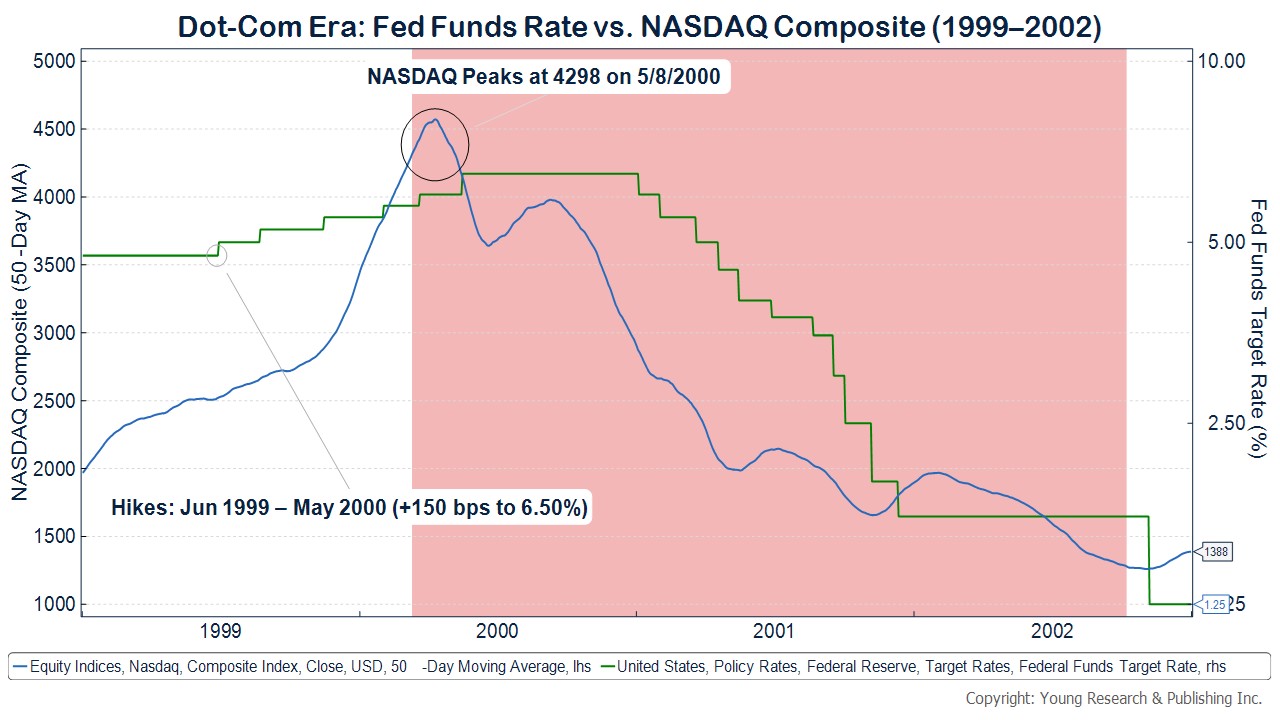
Meanwhile, the AI spending continues, helping to fuel GDP, corporate earnings, and stock prices. Businesses and investors are directing tens of billions toward AI infrastructure, software, and applications.
We’ve just wrapped up a better-than-expected earnings season for Q2, and from what I can tell, Q3 looks positive as well. I believe when paired with a Federal Reserve in rate-cutting mode, the combination of earnings growth and AI investment creates a potentially favorable backdrop for equities. A bubble may eventually form, but it doesn’t appear to be on our doorstep today. If spending slows, earnings soften, and the Fed reverses course, then conditions would most likely shift. But for now, fundamentals seem to remain supportive.
As always, we’re here to help you navigate what’s next. If your financial situation has changed or if you have questions about your investment portfolio, please don’t hesitate to call us at (800) 843-7273.
Warm Regards,

Matthew A. Young
President and Chief Executive Officer
 Client Portal
 Secure Upload
 Client Letter Sign Up